
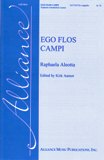
Ego Flos Campi
$1.70
Composed by Raphaela Aleotta
Edited by Kirk Aamot
Voicing: SAT/SATB a cappella
Catalog number: AMP 0824
About the composer
Raphaela Aleotta (b. c1570, Ferrara – d. after 1646) established herself as a conductor, composer and teacher in one of Ferrara’s celebrated late-Renaissance musical centers, the Augustinian convent of San Vito.’ As a very young child, Raphaela studied voice, keyboard and composition with private tutors hired by her father (tutors included Alessandro Millerville and Ercole Pasquini.) In recognition of her outstanding musical talent, Raphaela entered the San Vito convent to continue concentrated musical studies. At some point before her fifteenth birthday, Raphaela decided to remain at the convent indefinitely, ignoring invitations from suitors to return to public life. Raphaela became a teacher at the convent and musical director of an ensemble that included 23 musicians.3 During her time as leader of this ensemble, Raphaela composed Ego flos campi and fifteen other motets that are included in Sacre cantiones (1593) – the earliest known published collection of sacred music by a woman composer.
Concerning the Ornaments
Singers may enjoy adding the suggested ornaments included in this edition, either in rehearsal or performance. They are modeled on examples and principles from Giovanni Camillo Maffei’s treatise on singing, which was published in Naples, Italy in 1562. Maffei, a medical doctor and respected amateur singer, codified many principles of canto di glossi (singing with ornamentation) commonly in use during the sixteenth century. He cautioned fellow singers to take turns when adding ornaments and not to add more than three or four during the course of a composition. Also, he believed the vowel “oh” was the best one to use when singing embellishments. As an example for others to follow, Maffei wrote out embellishments for Francesco de Layolle’s (1492-1540) madrigal “Lasciar il velo.” Here are two of Maffei’s suggestions:

1 Barbara Garvey Jackson, “Say Can You Deny Me” A Guide to Surviving Music by Women from the 16th Through the Eighteenth Centuries (Fayetteville, AR: University of Arkansas Press, 1994), p. 14. There is some uncertainty as to whether Vittoria Aleotta is a sister of Raphaela or the same person. In her dissertation, The Madrigals and Motets of Vittoria/Raphaela Aleotti (Ph.D. diss., Kent State University, 1982), Ann Carruthers-Clement concluded they are the same person on the evidence that Vittoria is not mentioned in her father’s will, and the name Raphaela cannot be found in family documents prior to her entering the convent (references to Vittoria are scarce after that time).
2 Andriano Cavicchi, “Vittoria Aleotti, Raphaela Aleotti,” in Julie Anne Sadie and Rhian Samuel, editors, The Norton Grove Dictionary of Women Composers (New York: W. W. Norton, 1994) p. 243.
3 Ibid.
4 Martha Furman Schleifer and Sylvia Glickman, editors, From Convent to Concert Hall: A Guide to Women Composers (Westport, CT: Greenwood Press, 2003), p. 27. Two of the motets in this collection were composed by Ercole Pasquini, one of Raphaela’s early teachers.
5 Giovanni Camillo Maffei, “Letter on Singing,” trans. Carol MacClintock in Readings in the History of Music in Performance. (Bloomington: Indiana University Press, 1979.)

The embellishments in this edition, given above the score in ossia measures, may be performed by soloists while the rest of the choir sings Raphaela’s music or by all the singers. In general, embellishments should be sung a bit softer than the main notes and the tempo should remain steady, rather than slowing to accommodate the ornaments. The text underlay from the main notes should be applied on the same beats to the embellishments.
Source
This editor used the transcription provided by Martha Furman Schleifer and Sylvia Glickman in Women Composers: Music Through the Ages, Volume I (New York: Prentice Hall, 1996). The source for that transcription is included in Il Desiderio (1566), preserved complete in four printed partbooks in the Bayerische Staatsbibliothek, Munich (MS 2804/75).
Text
Song of Solomon, 2:1-3
Ego flos campi, et lilium convalium. Sicut lilium inter spinas; Sic amica mea inter filias.
Sicut malus inter ligna silvarum, Sic dilectus meus inter filios.
I am the flower of the field, and the lily of the valley. As the lily among thorns,
So is my love among the daughters.
As the apple tree among the trees of the wood, So is my beloved among the sons.
Kirk Aamot
Montana State University
Bozeman, Montana
| Edited by | Kirk Aamot |
|---|---|
| Composed by | Raphaela Aleotta |
| Voicing | SAT/SATB a cappella |
Reviews
There are no reviews yet.